
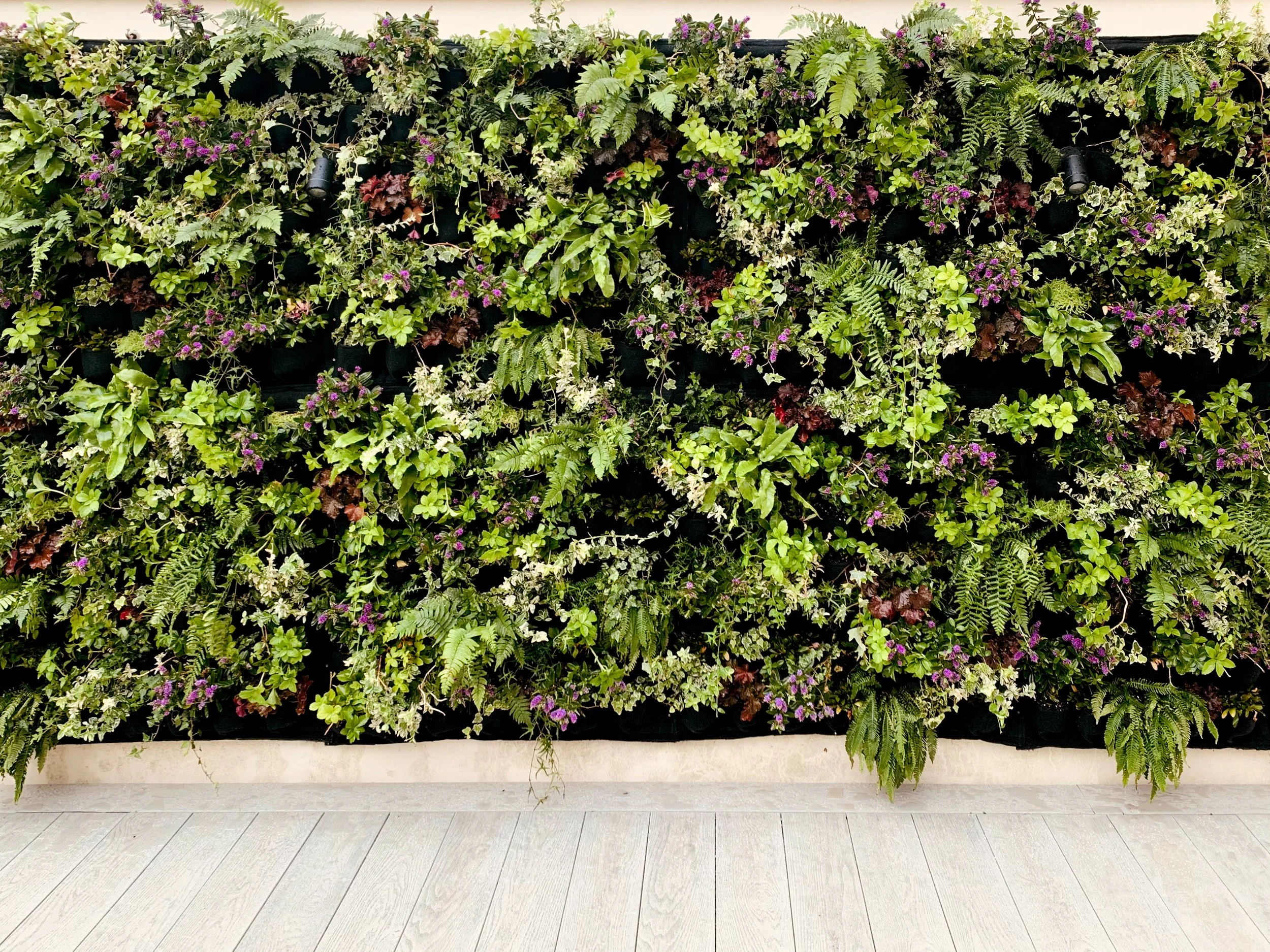
Living walls
The Plant Hunter designs and installs living walls for residential gardens and commercial settings across Surrey, Twickenham and Richmond. Paul Studholme uses the Fytotextile fabric pocket system with integrated drip irrigation on every installation. Completed projects include a 30 sq m installation at the Radnor Gardens cafe in Twickenham (2021) and a residential living wall, also in Twickenham. Based in East Horsley.
Who this is for: clients looking for a planted vertical surface on an exterior wall, fence panel, interior partition, or commercial frontage. Not suitable for very exposed walls with no irrigation provision; see "what living walls are not" below.
What a living wall is
A living wall is a planted vertical surface, built against a fence, exterior wall, interior partition or freestanding frame. Unlike a trellis with climbers trained across it, a living wall holds plants in a structured layer of growing medium, planted densely enough that the surface behind disappears.
The result is more like a planted border arranged vertically than a wall with a few climbers on it. Done well, it changes the character of a space entirely. It’s particularly useful on a boundary that cannot be screened by conventional planting design, or in a commercial space where planted surfaces make a strong visual statement.
What living walls are not
Living walls are not suitable for every site. A very exposed wall with no irrigation provision, and no realistic way of adding one, will not sustain a planted system long term. Living walls work where the irrigation can be properly integrated and the plant selection is matched to the specific aspect and light levels. Paul will say so at the outset if a site is not right for one.
The Fytotextile system
Paul uses the Fytotextile living wall system for every installation. Each plant sits in its own fabric pocket of growing medium. The fabric acts like capillary matting, where irrigated moisture is absorbed across the whole panel rather than drawn down into individual pockets, distributing water more evenly across the system.
At the top of each panel, a Velcro strip integrates a drip irrigation line neatly into the structure. Panels join using the same Velcro system, keeping the installation tidy and the irrigation built in rather than bolted on afterwards.
The system hangs on a timber frame and comes in a range of sizes, which allows it to work across a variety of wall shapes and scales, from a small residential fence panel to a large commercial frontage.
Where drip runoff needs to be managed, a gutter can be fitted at the base and piped to a drain point.
Irrigation
Every Fytotextile installation includes integrated drip irrigation from the outset. A living wall without a reliable watering system will fail within months, particularly in warm weather, as the fabric dries out rapidly regardless of rainfall. The irrigation is designed around the planting and the wall orientation: aspect, exposure and the water requirements of the specific plants all affect how the system is set up.
For more information on how Paul approaches irrigation design, see the Irrigation page.
Plant selection
Plants for a living wall are chosen differently from plants for a border. They need to establish quickly in a relatively shallow growing medium, tolerate the conditions of a vertical surface including drainage rate and airflow, and perform without the root run that a planted bed provides. Plant choice also varies considerably depending on aspect.
Full sun walls
Erigeron karvinskianus performs reliably in full sun, producing its small white and pink daisy flowers over a long season. Nepeta works well at mid-level for colour and coverage. Thyme and rosemary both handle sun and heat, and add structure at the edges of panels. Carex in its various forms provides contrasting texture and holds its form through the year. Lavender is possible on sheltered sunny walls where conditions stay reasonably dry.
Shaded walls
Ivy is the most dependable performer in shade, providing dense coverage and year-round reliability. Hakonechloa brings soft grass movement to shaded panels. Pachysandra provides low, spreading ground-level coverage. Libertia works in partial shade and adds upright structural interest. Sedums of the more spreading types do well in lighter shade. Ferns are particularly effective in shaded living walls; there are many suitable types including Asplenium and Dryopteris. Vinca and Ajuga both provide colour and coverage in shade without demanding conditions the system cannot provide.
Exposed walls
On exposed walls where wind is a factor, plant selection narrows. Erigeron handles exposure well. Ajuga, Carex, Sedum and thyme are all resilient enough to cope without becoming unsightly. The priority on exposed walls is plants that hold their structure rather than becoming battered and ragged through winter.
Sheltered walls
Sheltered walls open up more options. Nepeta and lavender both work well in sheltered conditions with reasonable sun. Thyme is reliable. Ornamental grasses including Carex, Pennisetum, and Stipa give movement and seasonal interest that more exposed positions cannot sustain.
Plants to avoid
Small succulents tend to rot off in the Fytotextile system; the moisture distribution does not suit plants that need sharp drainage and dry conditions between watering. Anything delicate will struggle as the system effectively leaves plants to their own devices between maintenance visits. Annuals are not suitable as they need replacing every year, which makes no sense in a planted system designed to establish and mature over time. The palette should stick to perennials, grasses and herbaceous plants.
Completed projects
In 2021, Paul installed a 30 sq m Fytotextile living wall at the Antipodea cafe in Radnor Gardens, Twickenham. A commercial installation at a community cafe on the Thames, it showed the system at scale in a high-footfall public setting. The planting included Heuchera, Carex, Erigeron karvinskianus, ferns, ivy, Ajuga, and Festuca glauca across the panels, with Phormium and Miscanthus in Corten steel planters complementing the wall along the cafe frontage, and held its planting through five growing seasons of public use before the cafe closed.
A further residential living wall was installed in Twickenham. The planted door shown below is also at Radnor Gardens, set into the decked seating area.
-
![Fytotextile living wall at Radnor Gardens Cafe, Twickenham]()
Planted living door, Radnor Gardens, Twickenham
-
![Residential Fytotextile living wall, Twickenham]()
Residential Living Wall, Twickenham
-
![Planted living door, Radnor Gardens, Twickenham]()
Living Door, Twickenham


Maintenance
Living walls need ongoing attention to perform well long term. Paul offers maintenance visits once or twice a year, covering growth management, planting refreshes where any areas need attention and checking irrigation performance. The frequency depends on how the wall is developing and how quickly the planting matures.
Maintenance visits are available for installations Paul has built. If you have a living wall installed by another company that is underperforming, get in touch.
Residential and commercial
The Plant Hunter installs living walls for both residential gardens and commercial settings. The catchment area follows the same Surrey footprint as the garden design work, which includes East Horsley, Cobham, Weybridge, Guildford and the surrounding villages. For commercial projects, the catchment extends to Twickenham, Richmond and the wider south-west London area.
Discuss your living wall
If you have a wall or fence panel that would suit a planted installation, get in touch. Paul can assess whether the site is right for a living wall and, if so, specify the system and planting around the aspect and conditions.
Frequently Asked Questions
-
The Plant Hunter uses the Fytotextile fabric pocket system on every installation. Each plant sits in its own fabric pocket with integrated drip irrigation built into the panel structure.
-
Yes. Every Fytotextile installation includes integrated drip irrigation from the outset. A living wall without reliable irrigation will fail; the system is designed with irrigation as a core component, not an add-on.
-
Yes. Paul offers maintenance visits once or twice a year covering growth management, planting refreshes and irrigation checks. Maintenance is available for installations he has built.
-
For residential living walls, The Plant Hunter covers East Horsley, Cobham, Weybridge, Guildford and the surrounding villages. For commercial installations, this also includes Twickenham, Richmond and the wider south-west London area.
-
No. Very exposed walls with no irrigation provision are not suitable for a living wall long term. Paul will assess the site and say so at the outset if it is not the right solution.
-
Possibly. Get in touch and Paul can advise on the specific installation.